• Skip to main content
  • Skip to primary sidebar
  • Skip to footer

The Hail Shop USA

Auto Hail Repair Denver

  • Auto Hail Repair
  • Paintless Dent Repair
  • Total Loss
  • About
    • Customer Care
    • FAQ
    • Our Work
    • Reviews
    • About
    • Blog
  • Locations
    • Denver, CO
    • Madison, WI
    • Springfield, MO
  • Contact

Jan 18 2022

Insurance company totaled my hail damaged car, now what?

When your insurance concludes that your vehicle is considered “totaled” due to hail damage, you will probably have a few questions. The Hail Shop USA is an paintless dent repair company that specializes in the repair of hail damaged vehicles (auto hail repair) and questions about a “totaled” hail damaged car is very high on the inquiry scale.

In this article, we will go over some of the most FAQ about a totaled out vehicle as a result of a hail storm.

  1. My vehicle still runs, why is it considered totaled?This is a big one and we understand why. If the vehicle is still mechanically sound and drives just as it did before the hail damage, how did this happen?

    A car will be declared totaled from hail damage if the cost to repair the dents, dings, and any broken glass, plus its salvage value, is higher than the actual cash value of the vehicle.

    For example, if your vehicle has a Kelly Blue Book value of $4,500 and the paintless dent repair company has estimated that there is $4,250 worth of auto hail repair and you add that to the salvage value (let’s say $500 to make the math easy) – that totals $4,750. This vehicle would be considered totaled.


  2. Can I still keep the vehicle if my insurance adjuster said it’s totaled?

    If you decide to keep the vehicle, the insurance company will write you a check for the ACV (Actual Cash Value). Next, your auto insurance company will issue a salvage title on the vehicle, and you will be responsible for making repairs or not to make any repairs to the car if you do decide to keep it.

    If you keep the vehicle, as long as there is no loan on the vehicle, and decide NOT to repair the hail damage and the car is involved in an accident or sustains additional hail damage – you will get no additional money to repair the existing damage.  No insurance company will insure you against hail damage if the car is already damaged.

  3.  Is a vehicle with a Salvage Title insurable?If your car is declared a total loss due to hail but you wish to keep driving it, you may be able to get your insurance provider to pay you the difference between the vehicle’s value before the damage occurred and its salvage value, minus your deductible. Beware though: You may need an inspection before the car is allowed back on the road, and your title will be forever branded, making it potentially difficult to insure.  USA Today excerpt credit.

    Liability Insurance is probably going to be your best option with a Salvaged Title on a hail damaged vehicle.

If you have questions about keeping or repairing a hail damaged vehicle, call the experts at The Hail Shop USA. We have restored hundreds of hail damaged vehicles that have been deemed “totaled” by insurance companies.

You can schedule an estimate or free consultation. In many cases, you can send us pictures or video of the damage by email.

 

Written by Carrie Atkins · Categorized: Auto Hail Repair

Dec 25 2021

Why are we seeing hail in the winter months?

Typically, we experience sleet in the wintertime months and hail during the warm months of summer – so why is it hailing in December?

While sleet and hail are both forms of frozen precipitation, they form in completely different ways but before we get further into these curious frozen weather phenomenons, let’s discuss all of the forms of precipitation.

There are five primary types that eventually reach the ground: snow, sleet, freezing rain, hail, and rain.

RainRain

When the air is warm enough all the way down to the earths surface, it’s just plain old rain. Further explained, when heat from the Sun turns moisture (water) formed from plants and leaves, as well as oceans, lakes, and rivers, into water vapour (gas), which disappears into the air. The water vapor then rises and turns into clouds.

When the water vapor cools and condenses, it then turns BACK into water. When the water droplets get too large and heavy to suspend, they fall as rain.

Snow

Snow forms when tiny ice crystals in clouds stick together to become snowflakes. If enough crystals stick together, they’ll become heavy enough to fall to the ground.

Snowflakes that descend through moist air that is slightly warmer than 0 °C will melt around the edges and stick together to produce big flakes.

Snowflakes that fall through cold, dry air produce powdery snow that does not stick together.

Snow is formed when temperatures are low and there is moisture in the atmosphere in the form of tiny ice crystals.

Freezing Rain

Freezing rain develops when warm oceanic air rises up and over the cold air, producing liquid precipitation that falls through the cold layer. The falling droplets become supercooled and freeze on impact with the cold surface causing freezing rain. Freezing rain is the precipitation type with the highest rate of accidents and death during the weather event.

Freezing rain occurs only when the earths surface is below freezing temperatures.

Sleet

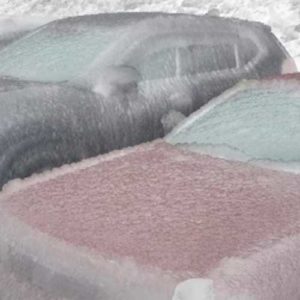
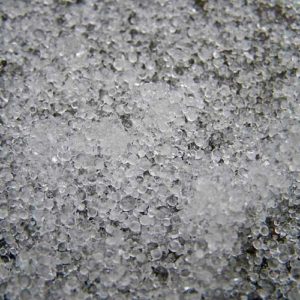
Sleet is oftentimes confused with freezing rain but the two, in fact, are very different. Sleet is simply frozen raindrops and occurs when the layer of freezing air along the surface is thicker. This causes the raindrops to freeze before reaching the ground. Sleet isn’t as dangerous as Freezing Rain because instead of freezing when it hits the earths surface, sleet bounces off of objects on impact.

Sleet occurs when snowflakes only partially melt when they fall through a shallow layer of warm air. These slushy drops refreeze as they next fall through a deep layer of freezing air above the surface.

Hail

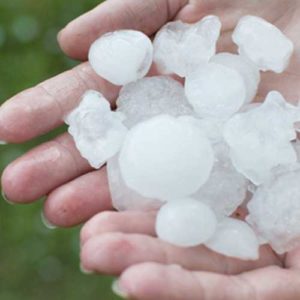
Hail is essentially oversized sleet. Hail is frozen precipitation that can grow to very large sizes through the collection of water that freezes onto the hailstone’s surface.

Hail typically forms in spring, summer or fall thunderstorms. First, soft, snow-like particles form in subfreezing air at the top of a thunderstorm. (Yes, even in the middle of summer, the tops of thunderstorms are below freezing).

The hailstones grow bigger in the clouds as ice crystals and cloud droplets freeze onto them. They’re held suspended in the clouds by strong winds that push up into the storm.

Finally, once the hailstones grow too heavy, gravity causes them to fall to the Earth.

Hailstones come in a variety of shapes and sizes. They can be lumpy, bumpy, and may even take the shape of small spikes. Hailstones must be at least 0.2 inches in size.

Hail typically forms during the warmer months of summer.

Why are we seeing hail in the winter months?

As you have read above, you now know that the months in which hail forms doesn’t depend on seasons but the temperature of the season.

Hail requires cold in the upper atmosphere, where it forms. A raindrop forms and begins to fall, but an updraft takes it into the freezing zone, where it freezes. It begins to fall again, but another updraft takes it back up, where it acquires another layer of ice. After several such cycles, the frozen particles fall as hailstones. It may be cold or not so cold on the ground.

Typically, the winter months display cooler temperatures and the summer months  are warmer. This isn’t always the case, much like we experienced in Kentucky this December of 2021.

The average temperature in Kentucky during the month of December is high 45.4°F and low 29.9°F. December 11, 2021 clocked in at a high of 66°F and low of 54°F.

On December 10, 2021, a violent, long-tracked tornado moved across Western Kentucky, producing severe to catastrophic damage in numerous towns. In Paducah, KY on December 11, 2021 – 2.75″ hail fell from the sky resulting in hail damage to vehicles and homes.

“The hail recorded earlier in the evening Sunday from the supercells ahead of the cold front was very impressive. Especially for the time of year. A few locations even observed hail damage to vehicles and homes. Ping pong ball sized hail was even observed by a NWS employee in the Paducah area.” – WPSD Local.

2021 has proven to be the year of record breaking and unseasonably warmer winter months….and unseasonable weather.

Written by Carrie Atkins · Categorized: Uncategorized

Sep 23 2021

Hail! Flying High Under the Radar No More

As Hail Occurrences Increase, So Do Your Insurance Rates

In an article by The Weekly Planet, Alex Kubicek says that “Hail is expanding its footprint across the country at the same time that it is becoming more frequent in the central United States.”

Who is Alex Kubicek? His Twitter feed says – Weather guy, CEO of @UnderstoryWx, Board gamer.

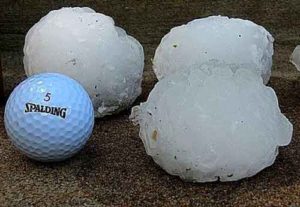
Golf Ball Sized HailIn August of 2021, Wealth & Finance, an international monthly publication dedicated to delivering high quality informative and up-to-the-minute global business content recognized Understory Inc with  top honor of Best Climate Change Insurance Solution 2021 for their work rewriting insurance for the era of climate change.
In layman terms. Alex Kubicek is a super, hard-core weather geek.

When scientists and climatologists list climate change’s biggest (or extreme) threats –  fire, floods, heat waves, & drought are at the top. With occurrences of hail increasing in spread and severity, hail is on its way to making that list.

Changes in Climate Extremes and their Impacts on the Natural Physical Environment white paper defines An Extreme Weather Event as, “the occurrence of a value of a weather or climate variable above (or below) a threshold value near the upper (or lower) ends (‘tails’) of the range of observed values of the variable.” Source.

How much money does hail damage cause per year in the United States?

The catastrophic effects of extreme hail occurrences include:

Crop Damage – Hail annually causes billions of dollars in damage worldwide to crops and property combined.

Personal Property Damage – In 2019, over 7.1 million US properties were affected by hail damage. Between 2008 and 2014, US insurers paid roughly $5.37 billion for auto insurance claims, according to hail data. The highest claim frequency was recorded in 2011 with 4.3 claims per 1,000 insured automobiles in the US due to hail damage. Source.

How do these hail occurrences effect personal property?

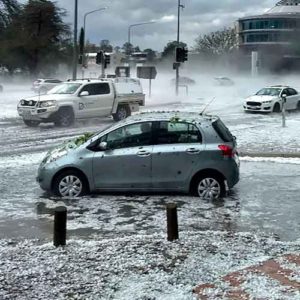
Mini Car in Hail StormFrom damaged roofs, and personal property damage to hail damaged vehicles  – insurance companies are paying out millions per year to repair the effects of hail damage. We know this.
The problem though is how many of these hail damage claims are actually legitimate?

It works kind of like this. A hail storm hits a portion of Austin, Texas. Not the entire city but more like a span of approximately 25 city blocks. Within those 25 blocks are residential neighborhoods, a couple of car lots, and a shopping center.

How do these hail occurrences effect property and casualty insurance companies?

After a hail storm, it is common for local or out-of-town roofing contractors to visit these neighborhoods and distribute sales paraphernalia in hopes of earning the contract to repair the hail damaged roofs. The same goes for paintless dent repair companies.

The problem is that not every roof or vehicle has the same severity of damage. Insurance fraud is a significant problem after major storms, partly because crooked contractors deceive customers about the extent of roof damage.

“If there is a high rate of weather related home damage or claims being filed in your neighborhood, your insurer will raise the rates for the entire area. This rate increase will affect your premiums regardless of whether or not you recently filed a claim.” Source.

How do these hail occurrences effect people?

“We really don’t know a lot about how the weather affects people. There has to be a better way to understand the weather than what we’re doing,” says Kubicek.

Kubieck’s company Uderstory is seeking to find a better way to detect the actual effect each unique hail occurrence can have on a farmers crops, a personals personal property, their vehicles, etc.  This, in turn, will better help property and casualty insurance adjusters understand just how much damage was sustained based on scientific data.

What does this mean?

Understory has developed what is called an “unmatched hyperlocal network” of ground-level sensors spaced two miles apart throughout a city or other area. Each sensor measures wind, rain and hail by force, direction and angle of impact, 120,000 times a second. That data allows analysts to precisely estimate storm damage, he said. Source.

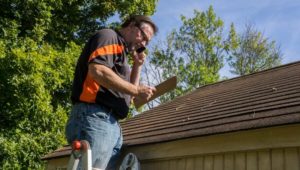
Roofing ContractorWith this technology, insurance estimators can go into a hail storm damaged area with an understanding of how much damage they should expect to see. If a roofing company or a paintless dent repair company has already estimated the cost to repair the damaged sustained on a roof or vehicle before the insurance estimator has actually seen the damage, they can quickly determine if their estimate is within the range of the data they have received from the sensors.

If a contractors estimate is grossly inflated, the insurance adjuster can visit the property to re-evaluate the damage and deliver a reimbursement amount that more accurately reflects the damage.

Ultimately, this technology will prevent the insured from incurring a cost increase on their property and casualty insurance and vehicle insurance policies.

Hail Sensors in Hail Alley

Hail Sensors - KubicekCurrently, there are over 600 sensors placed strategically across hail alley. Understory has installed sensors in Dallas-Fort Worth, Denver, Houston, Kansas City, and St. Louis – all producing what Kubicek calls “litigation-quality data” with a 97% accuracy rate that can hold up in court.

The insurer hopes that the data obtained from the sensor will help to more effectively handle future claims.

Written by Brandon Atkins · Categorized: Insurance, News

Aug 12 2021

How do you properly wash a car?

How to hand wash car wash like a pro

You’ve just had the hail damage repaired on your vehicle and you are ready to get it back to looking new again. Follow these simple steps to properly wash your car like the pro’s at The Hail Shop USA.

Gather the materials you will need to wash your car.

    • A pressure washer, car wash nozzle or a garden hose spray nozzle. 
    • 2 Heavy duty buckets. You can pick-up a 5 gallon bucket at your local hardware store for under five bucks. You’ll use one for soapy water and one as a dirty rinse bucket. It is also great for storing your car washing gear.
    • A sponge.
    • Microfiber wash brush, microfiber applicator, and microfiber cloths. Microfiber will both remove dirt and wick away water simultaneously. Plus, it reduces friction between the towel and your car for a safer way to dry without scratching.
    • Streak-free window glass cleaner.
    • Car washing foam. Car washing foam eliminates dirt, grime and environmental contaminants with massive amounts of dirt fighting, sudsy foam. We like this one sold on Amazon
    • Butter wet wax.

Wash your car like a champion

  1. Spray down the vehicle. Use a pressure washer, car wash nozzle or a garden hose with a spray nozzle (wide spray setting) to rinse most of the dirt, grime, and grit off the entire exterior panels.
  2. Start at the top. Use your microfiber wash brush and extremely sudsy water with your car washing foam to clean the vehicle. Use a side-to-side motion, never circular motions. Start at the roof and then the hood, and then work your way down. After you wash a panel, make sure you rinse your microfiber wash brush in your dirty water bucket to remove any sentiment to avoid scratching your paint.
  3. Wash and then rinse. Repeat. After each individual panel is washed, rinse it to avoid soap streaking. Empty your dirty water bucket between every other panel you’ve washed.
  4. Wash the wells. Dust, debris, and dirt love to live in your door wells and crevices so do not forget to wash them. Use a sponge to clean these areas.
  5. Don’t air dry, hand dry. When you leave a car to dry naturally, it can result in a streaky finish. To avoid streaking, make sure to dry each panel using a microfibre cloth or towel. If you have a leaf blower handy, this can be a great tool to blow out in between the wells. If you don’t, use an old towel to wipe these areas dry.
  6. Clean the glass. Give both the exterior and interior glass a good cleaning with your steak-free glass cleaner. Use a clean microfiber towel to clean all glass and windows.

    Pro-tip: Designate washing zones by color coding your microfiber cloths. For example, use only blue microfiber cloths to clean glass. Use orange for interior detailing and yellow for exterior detailing.

  7. Wax and polish. Once the car is clean, waxing the with Butter Wet Wax will help it look even better, protect the paint from ultraviolet rays, and adds a protective barrier from the elements.

The nations #1 provider of Paintless Dent Repair & Auto Hail Repair.

If your vehicle has hail damage, Auto Hail Repair with the professionals at The Hail Shop USA.

Written by Brandon Atkins · Categorized: Tips

Jul 13 2021

Global Warming Effects on Hail Alley

Starting somewhere around March every year,  a large swath of the country braces for hail. Known as Hail Alley, the region stretching from Wyoming to Texas receives more hailstorms, and more severe ones, compared to other parts of the country. 

Features on land and in the atmosphere make perfect hail conditions for this part of the U.S.

In this article, we will explore how climate change could effect three of the hardest hit states that reside in the path of Hail Alley.

How will Climate Change effect Kansas?

Temperature

Kansas’s climate is changing. In the past century, most of the state has warmed by at least half a degree (F). The soil is becoming drier.

Rain / Snow

Climate change is creating an “unprecedented” risk of severe drought in the Southwest and Central Plains. Rising temperatures and decreasing rainfall mean that future drought could be more extreme than any drought seen in at least the past 1,000 years and the effects could reverberate for urban dwellers and farmers across the regions.

Winters

Warming winters and changes in the timing and size of rainfall events have altered crop yields. Over the next several decades, the amount of rainfall during the wettest days of the year is likely to continue to increase, which would increase flooding.

Hail Occurrences

The environmental conditions for large hail development are not changing with climate warming and that all favorable environments are equally likely to produce large hail.

Resources: Climate Central,

How will Climate Change effect Colorado?

Temperature

The climate of the Intermountain West is changing, with multiple independent measurements indicating an overall warming of about 2°F across the region in the past 30 years.  In 2020, Colorado experienced its seventh warmest year in more than a century of record-keeping. Average temperatures were 2.8 degrees higher than the average in the past century. 2016 through 2020 was the hottest-ever five-year period for the state, according to the NOAA’s National Center for Climate Information.

Rain / Snow

Coloradans are experiencing what is called a  “snow drought.”  This is what Colorado forecasters are talking about when they say snow cover across the West is lower than at any time over the past two decades. Snowpack is less than 80% of normal statewide with less than two months to keep building.

Hail Occurrences

The effects of climate change on hail and the resulting damage are hard to calculate because hailstorms require distinct ingredients, and global warming affects them in different ways.

To form, hailstorms require moisture, an updraft, variable winds and freezing temperatures at lower levels of the storm cloud.

Updrafts lift water droplets into the clouds, where they attract other droplets and freeze together, scientists say. Winds of varying speed and direction keep the droplets suspended in the cloud long enough to grow into hailstones. When they eventually fall, freezing temperatures in the cloud keep them from melting before they hit warmer air closer to the ground.

Climate change will likely increase updrafts, helping hailstones form, but it will inhibit two hail-producing conditions. Warmer temperatures will expand higher into the atmosphere, so falling hailstones have more time to melt before hitting the ground. And differences in wind speed and direction will subside.

Climate change will make the atmosphere moister, but the effect that will have on hailstones isn’t clear..

Resources: CPR, Andreas Prein – National Center for Atmospheric Research in Boulder, Colorado. Colorado Sun,

How will Climate Change effect Texas?

Temperature

Texas is home to 9 of the hottest cities in the U.S., with McAllen in the 2nd slot. Most of the state of Texas has warmed between one-half and one degree (F) in the past century. Texas is home to 9 of the hottest cities in the U.S., with McAllen in the 2nd slot.

Rain

Despite the increase in heavy storms, changing climate is likely to make water less available overall. As warmer temperatures increase evaporation and water use by plants, soils are likely to continue to become drier. Average rainfall is likely to decrease during winter, spring, and summer. Seventy years from now, the longest period without rain each year is likely to be at least three days longer than it is today. Increased evaporation and decreased rainfall are both likely to reduce the average flow of rivers and streams.

Snow

In the case of the Texas cold snap, the phenomenon began in the first week of January 2021, when air in the stratosphere above the Arctic warmed suddenly. This set up a slow-moving atmospheric chain reaction that weakened the polar vortex, the girdle of winds that keeps frigid air corralled at the North Pole, allowing it to spill out into the temperate regions of Asia, Europe, and North America. Once the cold starts rolling south, very little can stop it.

While these events happen about six times per decade, according to the National Oceanic and Atmospheric Administration, Cohen maintains that climate change has increased the frequency with which the polar vortex weakens and allow the cold to air to run amok.

Hail Occurrences

Based on research, there is some indication of more intense hailstorms in a warming climate. Since the 1960s, the annual number of reported hail observations has risen, both in frequency and the size of the hailstones. That rising trend, however, does not necessarily mean climate change is resulting in more hailstorms with larger hail, and could simply indicate that as populations grow, there are more people, living in more areas, able to send in hail reports.

Resources: Bloomberg,  AMS,  EPA.gov

Written by Brandon Atkins · Categorized: Uncategorized

  • « Go to Previous Page
  • Page 1
  • Page 2
  • Page 3
  • Page 4
  • Page 5
  • Interim pages omitted …
  • Page 15
  • Go to Next Page »

Primary Sidebar

Blog Categories

  • Auto Hail Repair (19)
  • Insurance (21)
  • News (5)
  • Paintless Dent Repair (7)
  • Tips (7)
  • Uncategorized (20)

Footer

The PDR Authority

The Hail Shop USA is the Midwest’s leading specialist in Paintless Dent Repair, providing factory-quality finishes without traditional filler or paint.

  • ✓ Auto Hail Repair Specialists
  • ✓ PDR Master Technicians
  • ✓ Unmatched Customer Care
  • ✓ Total Loss Advocacy

Connect With Us

See what our customers are saying and stay connected on social media.

Our Locations

  • Denver, CO720-515-4708
  • Springfield, MO417-861-6432
  • Madison, WI608-285-2634

Copyright © 2026 · Altitude Pro on Genesis Framework · WordPress · Log in